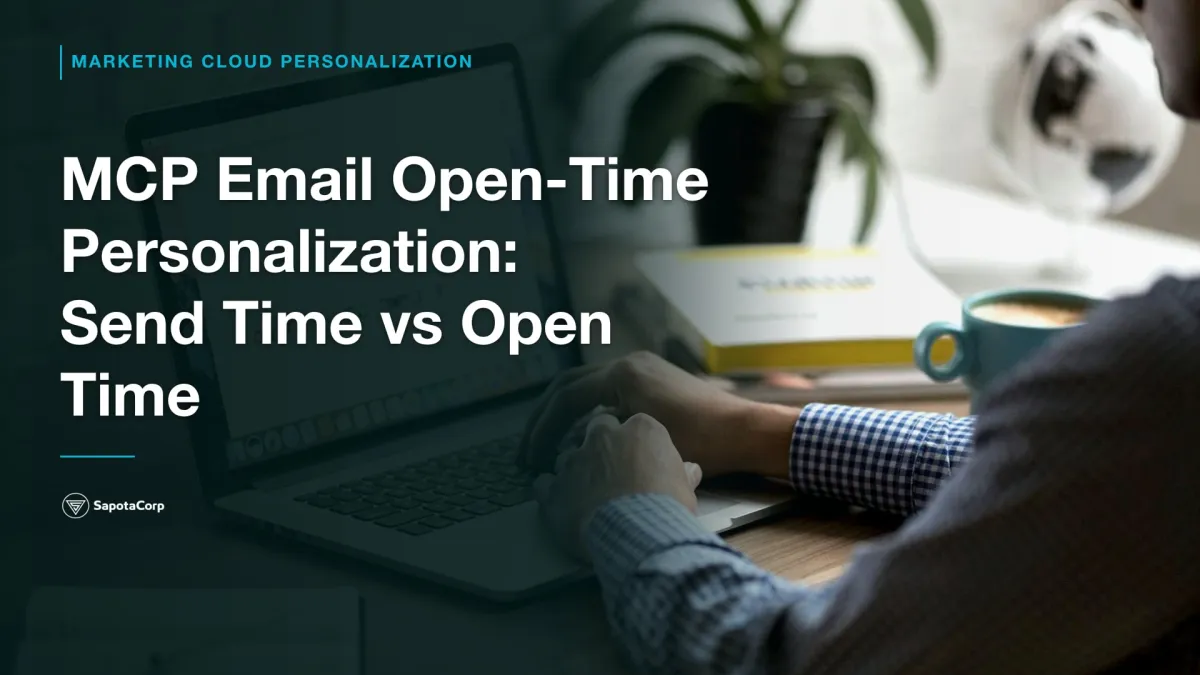
Email personalization happens at one of two moments. Send time is the obvious one: the email is generated, the recommendations are picked, the message is delivered with content already baked in. Open time is the alternative: the email contains placeholder elements that fetch fresh content at the moment the recipient opens the message. Marketing Cloud Personalization supports open-time rendering, but the trade-offs are larger than they look in the configuration UI.
The fundamental difference
A send-time personalized email is a snapshot. The marketing platform asks MCP "what should this person see?", gets the answer, embeds it in HTML, and queues the email for delivery. Whatever happens between send and open is invisible to the email. If the visitor's behavior changes, if items go out of stock, if recommendations would be different now, the email does not know.
An open-time personalized email is a live request. The HTML contains an image tag or iframe that points to an MCP endpoint with a unique recipient ID. When the email client renders the message, the request fires, MCP returns fresh content, the recipient sees what is current at the moment of viewing.
The two flows produce different content for emails opened at different times. Send-time emails always show the same content regardless of when opened. Open-time emails reflect whatever is current at open.
Why open-time matters for some emails and not others
The freshness window decides. Some emails are pegged to a moment in time and do not benefit from updating after send. Others have a long tail where content updating matters.
Open-time wins for:
- Cart and browse abandonment. The recipient browsed 3 days ago. Their interests have shifted. Open-time recommendations reflect any new browsing since then.
- Long-running newsletters. A weekly digest opened the next week should reflect the latest content, not last week's snapshot.
- Cross-sell after purchase. An email sent at purchase, opened a week later, can show items related to the purchase that have surfaced recently.
- Inventory-sensitive promotions. "Last chance" emails should not feature out-of-stock items even if those items were in stock at send time.
Send-time is fine for:
- Transactional emails. Order confirmations, shipping updates. Content is static and time-pegged.
- Time-bounded promotions. "Sale ends Friday" emails opened on Saturday are out of date regardless.
- Welcome series. First email in a sequence. The recipient has no behavioral history yet for open-time to use.
The decision is not technical preference. It is about what the email is for.
Infrastructure required for open-time
Open-time rendering puts a request between every email open and a server. That has consequences:
- Latency. The recipient opens the email. Their email client renders the body. The request fires. MCP responds. The response renders. If MCP is slow (>1 second), the recipient sees a placeholder before the content arrives. If MCP is unavailable, the placeholder stays forever.
- Scale. A campaign of 500,000 recipients produces 500,000 open-time requests over the days following send. The infrastructure has to handle the traffic spike.
- Privacy. The open-time request reveals to MCP that the recipient opened the email. Some email clients (most notably Apple Mail Privacy Protection) prefetch content automatically, breaking open-time as a tracking signal but still triggering the rendering. The platform sees opens that may not be real.
For programs running tens of thousands of campaigns, this is fine. For programs running occasional bursts, the infrastructure consideration is real.
Fallback strategies
Open-time fails more visibly than send-time. The placeholder is visible. If MCP times out, the recipient sees an empty box.
Three fallback patterns work:
- Default content baked into the email. The image tag points to MCP, but if MCP fails, the alt text or a CSS background renders a default. Visitors see something sensible even when the open-time call fails.
- Send-time backup. The email includes both send-time content (rendered up front) and open-time content (rendered at open). The open-time content shows when available. The send-time content fills in if open-time fails. Doubles the effort but bulletproofs the experience.
- Cache for the duration of the campaign. MCP returns content for a recipient and caches it. Subsequent opens by the same recipient hit the cache rather than re-rendering. Reduces load and improves consistency. The trade-off is that the second open does not necessarily reflect newer behavior.
Most production programs use a combination: cached open-time with default content as final fallback.
The send-time + open-time hybrid
A common pattern that works better than either alone: send-time personalization for the layout and primary content, open-time for the recommendation strip.
The layout (greeting, CTA, branding) is decided at send time. It is consistent for the recipient regardless of when they open. The recommendation strip is open-time. The "products picked for you" section reflects whatever MCP knows now, not what MCP knew at send.
This minimizes the fallback risk (the layout is always there) while capturing the freshness benefit where it matters most (the recommendations).
Tracking the lift of open-time over send-time
The honest measurement question: does open-time actually outperform send-time for this program?
The right test compares two cohorts of similar emails. One cohort uses send-time recommendations. The other uses open-time. Compare conversion rates, click-through rates, revenue per email.
Common findings on real engagements:
- For abandonment series and recommendation-heavy emails, open-time produces 5 to 15 percent lift over send-time.
- For evergreen content (newsletters with mostly editorial), the difference is small or negligible.
- For transactional flows, send-time and open-time are equivalent because the content is the same anyway.
The lift is real but contextual. A program-wide switch to open-time should be backed by measurement, not by the assumption that fresher is always better.
Common implementation mistakes
Five patterns recur:
- Open-time everything. Every campaign uses open-time, including transactional and time-bounded ones where it adds no value but adds risk.
- No fallback content. The image tag has no alt text or default. When MCP times out, recipients see broken images.
- Caching that ignores recipient updates. A first-week cache that does not respect new behavior. The recipient's browsing on day three is invisible because the cache served them day one's recommendations.
- No measurement. The team turned on open-time because the rep recommended it. No A/B test against send-time. No way to defend the choice.
- Render time exceeds reasonable thresholds. The MCP integration takes 2-3 seconds to return a response. Recipients see placeholders for the visible duration. The infrastructure has not been tuned for the actual scale of email traffic.
Open-time personalization is a real lever for the right campaigns and the right programs. Treating it as a default for everything wastes infrastructure and adds risk. Sapota's Salesforce team scopes open-time per campaign type rather than per program, and validates the lift with measurement before rolling broadly.
Configuring open-time email personalization in Marketing Cloud Personalization? Sapota's Salesforce team handles email integration, fallback strategy, and lift measurement on production engagements. Get in touch ->
See our full platform services for the stack we cover.