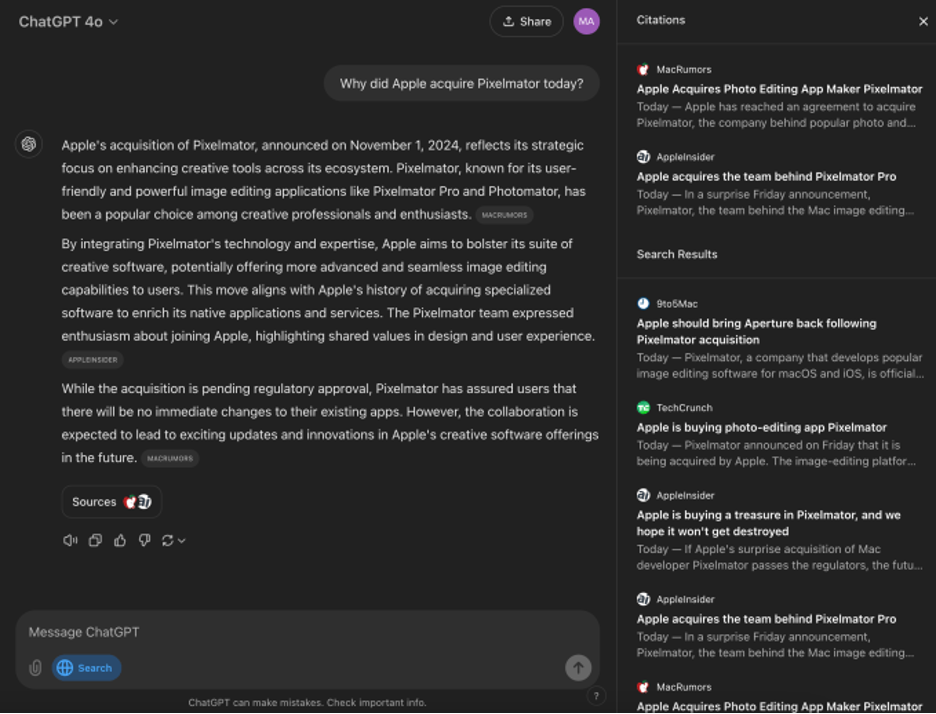
OpenAI's answer to Google search (Source: Maxwell Zeff)
ChatGPT Search Offers a Glimpse of the Future but Falls Short on Practicality
ChatGPT Search excels in generating real-time answers and has a clear, user-friendly layout. It gathers information from credible sources, listing them on the side, so users can verify facts quickly. However, using ChatGPT Search for everyday needs felt impractical; like other AI-based search engines (such as Perplexity and You.com), it struggled with short, navigational queries, which form a significant part of the searches we perform daily. For instance, quick searches like “weather,” “score updates,” or “local coffee shop hours” often fall short. Instead of providing direct links or accurate real-time updates, ChatGPT Search can offer misleading information.
The Short Query Dilemma: Where Google Still Reigns Supreme
Google has become the go-to search engine for billions of people primarily because it handles short queries effortlessly. These concise searches account for a major portion of Google’s daily traffic, often just two to three words long, allowing people to access familiar web pages or specific information instantly. ChatGPT Search, on the other hand, struggled with these types of queries. An example that highlighted this issue was a query for the “Nuggets score.” While Google instantly pulled up accurate real-time game results, ChatGPT Search showed incorrect information, revealing the challenge OpenAI faces in competing with Google’s reliability in fast, short searches.

Comparison of ChatGPT Search (left) and Google search (Right) for live NBA scores.
ChatGPT Search and “Hallucinations”: A Major Barrier to Trust
A significant issue with ChatGPT Search is its tendency to “hallucinate” – generating inaccurate or completely fictional content. For example, while searching for companies reporting earnings, ChatGPT Search showed outdated or incorrect information. This is a common issue in large language models, which sometimes fill in gaps with made-up content when precise data is unavailable. In some cases, the AI even provided broken links or incorrect contact information. While Google is not immune to similar issues with its AI features, these hallucinations undermine the reliability of ChatGPT Search as a dependable search engine.
A Potential Niche: ChatGPT Search’s Strength in Long-form Queries
Where ChatGPT Search shines is with long-form, research-oriented questions. For example, a query like, “What American sports league has the highest diversity?” generates a comprehensive answer by combining insights from multiple sources. Unlike traditional search engines, ChatGPT Search answers such complex questions without requiring the user to dig through dozens of articles. While Google can perform this task, ChatGPT Search offers a cleaner, less cluttered interface that’s more focused on answering directly. This advantage could allow ChatGPT Search to serve as a complementary tool to Google rather than a direct competitor.
OpenAI’s Challenge with Short Queries and Microsoft Bing as a Back-End
One limitation that holds ChatGPT Search back is its reliance on Microsoft Bing as its underlying search engine. Google’s algorithm remains unmatched for short, keyword-based searches, and this gives it an edge in meeting users’ needs. ChatGPT Search, powered by a large language model (LLM), is geared toward more detailed responses that require a structured question. Unlike Google, which excels at matching short queries to specific links, ChatGPT Search’s LLM is designed to process fully formed sentences, leading to mixed results with short phrases. If OpenAI wants ChatGPT Search to handle these efficiently, it may need to refine how it processes short queries or even consider building a unique search index.
The "Perplexity Problem": Are People Using AI Search Engines Differently?
Other AI-driven search engines, like Perplexity, have faced similar challenges, with users performing longer queries than they typically would on Google. Perplexity’s median query length is around 10 words, while Google’s is closer to two or three. This indicates that AI search tools are not yet suited to the type of quick, keyword searches that Google has perfected. Perplexity CEO Aravind Srinivas noted that users tend to view Perplexity and, by extension, ChatGPT Search, as tools for answering direct questions rather than web navigation. Until AI search engines can efficiently process shorter queries, they may have to accept a role as complementary tools rather than direct Google competitors.
Google as the “Front Door to the Internet”
Google’s ability to serve as the “front door to the internet” stems from its unmatched capability with short, navigational queries. ChatGPT Search, with its emphasis on rich, paragraph-like answers, currently serves a different purpose. In many cases, people turn to Google because they know it will direct them to the correct webpage, often without requiring any additional clicks or refinement of the search. For ChatGPT Search to dethrone Google, it must overcome this short query challenge. Until OpenAI can make ChatGPT Search equally effective with two-to-three-word requests, it’s unlikely to be able to replace Google for everyday tasks.
The Future of AI Search: Could ChatGPT Search Evolve into a Google Competitor?
OpenAI is aware of these issues and has plans to improve ChatGPT Search based on user feedback. CEO Sam Altman has expressed optimism about the future potential of ChatGPT Search, hinting at continued investment in the platform. With ongoing improvements, ChatGPT Search could potentially evolve into a more reliable alternative for routine searches. However, Google’s extensive experience and vast resources allow it to continuously optimize its AI capabilities. For OpenAI to compete effectively, it must address both its accuracy and user experience for short, high-frequency queries.
Can ChatGPT Search Compete with Google? The Verdict
Currently, ChatGPT Search offers valuable insights and a promising glimpse into the future of AI-powered search engines, especially for long, research-intensive questions. However, it lacks the reliability and precision required to replace Google for everyday use. As a complementary tool, ChatGPT Search can thrive alongside Google by filling in information gaps and simplifying complex queries, but replacing Google would require advancements in handling short, navigational queries. In the future, with improved accuracy and more fine-tuning, ChatGPT Search may stand as a viable alternative. Until then, however, Google’s practicality and dependability keep it firmly in the lead.
This analysis of ChatGPT Search shows the potential for AI-driven tools to redefine search engines while highlighting the obstacles they must overcome. For now, Google’s adaptability to various query types keeps it irreplaceable, but ChatGPT Search’s evolution could offer users exciting new search possibilities.





 Technology