1. What is Mojo?
Mojo is a specialized programming language designed to optimize AI and machine learning workflows. It leverages cutting-edge technologies like MLIR (Multi-Level Intermediate Representation) to deliver unparalleled performance, often up to 68,000 times faster than Python.
Behind its innovation are two pivotal figures:
- Chris Lattnerz: Co-founder and Modular’s director, known for his work on Swift, LLVM, and MLIR.
- Tim Davis: Co-founder and product lead, previously contributing to Google’s AI infrastructure.
Mojo supports integration with Python libraries, making it easier for developers to adopt without overhauling their existing workflows. Currently, Mojo runs on Ubuntu Linux and macOS, with Windows support on the horizon.

Chris Lattner (left) and Tim Davis (right)
Projects Showcasing Mojo
Mojo has already demonstrated its capabilities across various projects. For instance, rewriting Llama2 inference in Mojo resulted in a staggering 250-fold performance increase compared to Python. This improvement drastically reduces the time needed for token generation in natural language processing tasks, highlighting Mojo's potential in large-scale AI models.
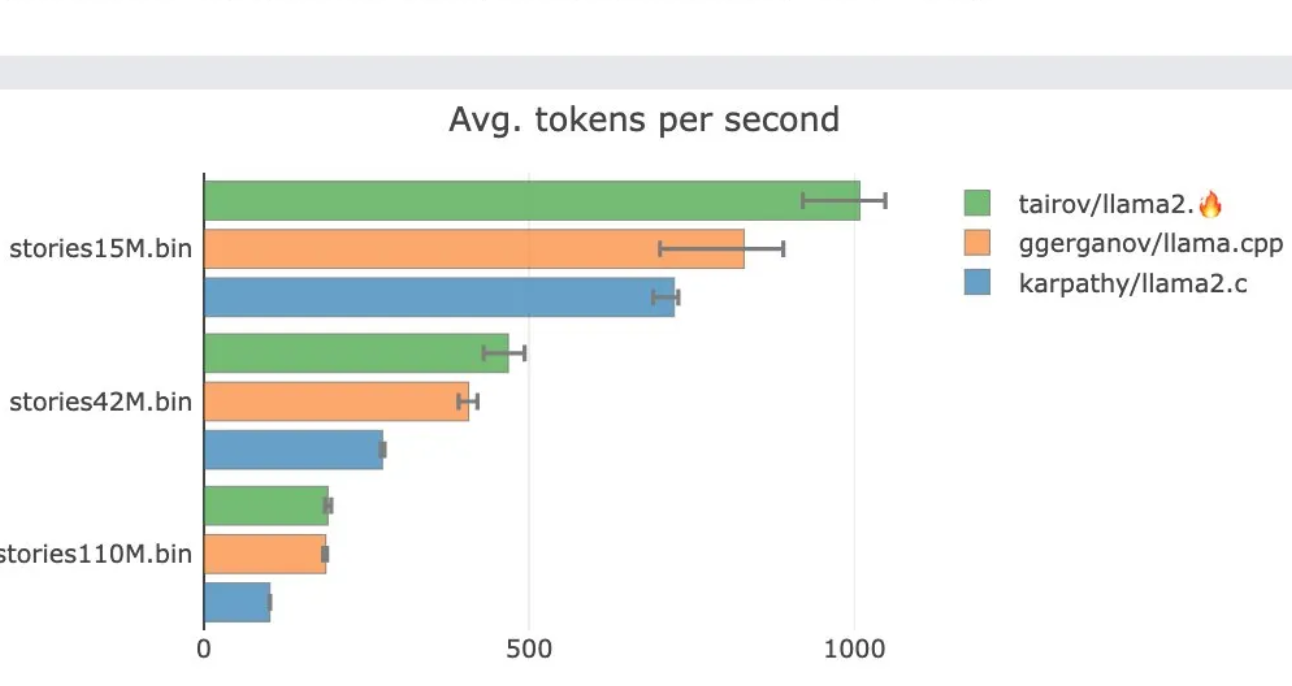
Avg. token per second graph
In another project, the Infermo library, written entirely in Mojo, facilitates the creation and training of machine learning models. It incorporates essential components such as activation functions and forward and backward propagation, making it an ideal tool for AI experimentation.
Mojo’s flexibility extends beyond AI. The Lightbug HTTP framework, for example, uses Mojo’s static typing and speed advantages to enable efficient web service development. Similarly, a scaled-down version of Stable Diffusion built in Mojo demonstrated reduced generation times, albeit with some early-stage limitations in output quality.
Quantum computing is another frontier where Mojo shines. Developers have created a simulation framework that simplifies quantum circuit operations using Mojo’s high-performance parallel computing features. This aligns Mojo with emerging quantum-focused languages like Quill and Cirq, positioning it as a versatile tool for next-generation computing challenges.
Mojo’s Key Innovations
Performance is Mojo’s most celebrated feature. By leveraging MLIR, Mojo achieves levels of optimization that Python, even with accelerators like NumPy or TensorFlow, struggles to match. Vectorization, multi-threading, and hardware acceleration are all seamlessly integrated into Mojo, enabling significant speedups across various tasks.
Another notable advantage is Mojo’s extensibility. It allows developers to customize pre- and post-processing workflows and replace core operations with tailored implementations. This adaptability is crucial for researchers and engineers working on unique AI problems that standard libraries cannot address efficiently.
Perhaps most importantly, Mojo integrates seamlessly with Python. Developers can use popular Python libraries such as NumPy, Matplotlib, and Pandas while benefiting from Mojo’s performance optimizations. However, this compatibility has some limitations, as Mojo cannot yet export its modules back to Python or import specific components from Python libraries directly. Despite these constraints, the integration ensures that adopting Mojo does not require abandoning the existing Python ecosystem.
Syntax and Features
Mojo’s syntax mirrors Python’s simplicity while introducing features for better performance and type safety.
- Data Types: Supports essential types like Int, Float, String, Bool, and Uint.
- Variables: var: For modifiable variables. let: For immutable variables.
- Functions: fn: Type-safe, inspired by Rust. def: Dynamic, like Python.
Mojo’s flexibility extends to Python compatibility but comes with a few limitations:
- Mojo modules cannot yet be imported into Python.
- Imports must encompass entire Python modules, not specific components.
Mojo lacks top-level code support, requiring function-based execution
The Impact of Mojo on AI Development
Mojo’s introduction marks a significant shift in AI programming. Its ability to combine ease of use with exceptional performance has far-reaching implications for the industry. Faster execution times reduce compute costs, making AI research and deployment more accessible to smaller organizations and independent developers. This democratization of AI could accelerate innovation across fields, from healthcare to finance.
Furthermore, Mojo’s high performance enables the development of more complex models and simulations. Tasks that were previously infeasible due to Python’s speed limitations are now within reach. This opens doors to more sophisticated AI applications, such as real-time decision-making systems and large-scale simulations.
However, Mojo’s impact extends beyond AI. Its versatility makes it a strong contender in fields like web development and quantum computing. As its ecosystem grows, Mojo could become a go-to language for high-performance programming across various domains.
Challenges and Future Prospects
While Mojo’s advantages are undeniable, its path to widespread adoption is not without challenges. Being a relatively new language, Mojo lacks the extensive libraries and community support that Python enjoys. Convincing developers to switch will require robust tooling, comprehensive documentation, and ongoing improvements.
Another hurdle is compatibility. While Mojo integrates well with Python, its current limitations may deter some users from adopting it fully. Expanding its interoperability and addressing these gaps will be crucial for its success.
Despite these challenges, Mojo’s open-source nature positions it for rapid growth. Released under the Apache 2.0 license, it invites contributions from developers worldwide, fostering a community-driven evolution.
Conclusion
Mojo represents a bold step forward in AI programming, combining the best aspects of Python and C. Its promise of unparalleled performance and usability has the potential to redefine how we approach AI and high-performance computing.
While it is too early to predict whether Mojo will replace Python, it is clear that it has set a new benchmark for what a modern programming language can achieve. For developers and researchers eager to explore the cutting edge of AI, Mojo offers an exciting opportunity to push the boundaries of what’s possible.
The question remains: Will Mojo dethrone Python, or will it become a powerful complement in the AI developer’s toolkit? Only time will tell, but one thing is certain— Mojo is here to stay.
For more information, visit Mojo’s official documentation and explore its growing ecosystem of projects and tutorials.







 Developer